
What DEXA shows that the others cannot
It is worth being specific about the questions DEXA answers that the simpler tools cannot even attempt.
- Regional muscle balance. Because lean mass is reported limb by limb, a DEXA scan can reveal a left-right asymmetry or an upper-versus-lower imbalance that a single body-fat percentage would completely hide.
- The distribution of fat. DEXA estimates the fat held deep in the abdomen separately from the fat under the skin, which is the distinction that actually carries the metabolic signal in men.
- Bone mineral density. This is the same technology used clinically to assess the skeleton, so a single scan tells you about the resilience of your bones alongside your fat and muscle.
How Osteoporosis is diagnosed: DEXA scan explained:
Osteoporosis can be diagnosed using bone densitometry, with dual-energy X-ray absorptiometry (DEXA) being the accepted method. This is a technique based on measurement of the attenuation (absorption) of low-dose X-ray beams to estimate bone mineral density (BMD). Measurements are usually made at the spine and hip (i.e. in the axial or central skeleton) and, in adults, expressed as T-scores in which the individual’s BMD is compared to the average BMD in healthy young women.
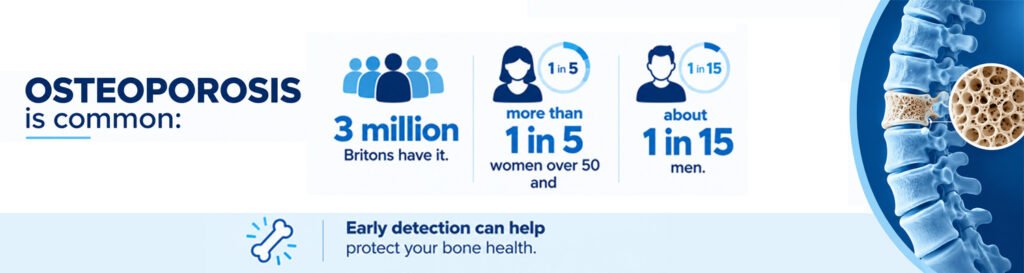
Osteoporosis can weaken your bone silently, increasing the risk of fracture and mobility issues. Early detection by Bone density (DEXA) scan is key to protecting your bone health.
Common warning signs:
- Frequent back pain.
- Gradual loss of height
- Stopped or hunched posture
- Reduced strength and mobility
- Bones that fracture easily after minor falls or injuries.
Why is a private DEXA scan important for men in their 40s?
From the age of 40, muscle mass gradually declines unless it is actively maintained, abdominal fat tends to increase, and bone density can quietly decline. These three elements can be measured precisely with a DEXA scan, providing an accurate assessment of body composition and bone density.